Gamification: how to attract the next generation to industry
Attracting “digital natives” to the industrial sector is a significant challenge. WorkInov addresses this by transforming industrial workstations into engaging and immersive interfaces.
 Jean-Michel Gaudron
05/05/2026
Gamification refers to the integration of game-based mechanisms into non-gaming contexts, particularly within work environments as part of industry’s digital transformation.
In practice, this involves introducing points, badges, leaderboards, progressive challenges and immersive narratives into daily tasks, whether on an assembly line, during training, or in operational performance monitoring.
By turning routine tasks into measurable mini-challenges, this approach enables workers to visualise their progress and find greater meaning in their contributions. It also serves as a powerful tool to attract younger generations entering the workforce: Millennials and Gen Z, who, according to the World Economic Forum, now represent 75% of the global workforce.
A cockpit inspired by video games for ArcelorMittal
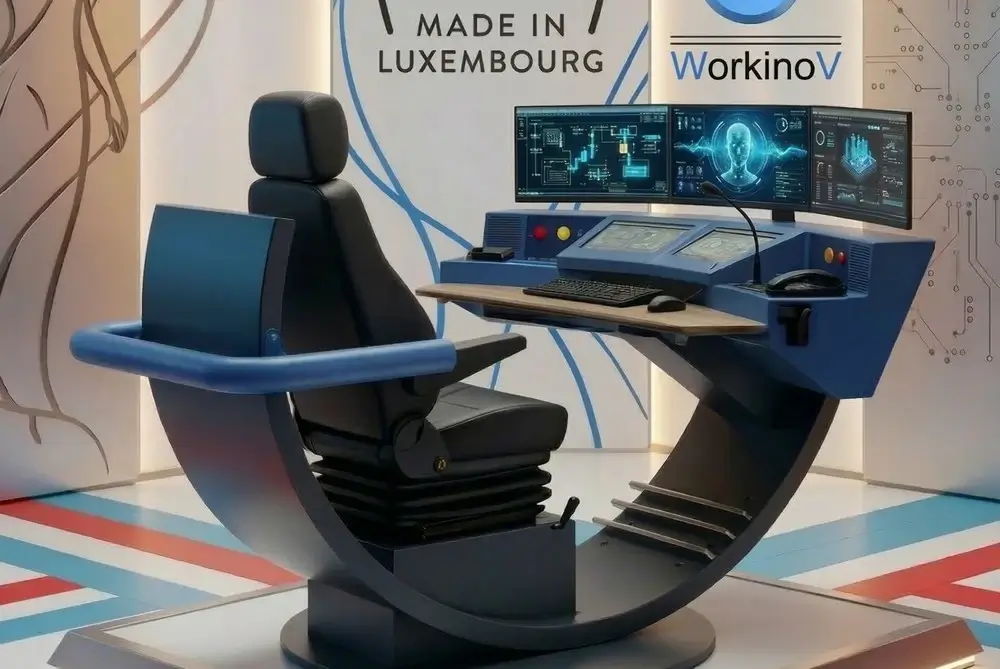
It is precisely with this in mind that WorkInov has developed a cockpit designed as a genuine video game for the control and monitoring of continuous casting operations at the ArcelorMittal steel plant in Belval. “Gamification aligns with the mindset and habits of young ‘digital native’ generations. It is an excellent way to capture their interest and attract and retain future operators from this new generation,” explains Philippe Guilloteau, ergonomist and designer at WorkInov, who presented his solution at the recent Global Industrie exhibition, attended by a delegation of Luxembourg industrialists as part of the L-DIH Crossborder Tour.
This initiative by the Luxembourg Digital Innovation Hub, coordinated by Luxinnovation, enabled a group of around fifteen Luxembourg industrialists to experience an exclusive and structured immersion at the heart of European innovation.
Using the Unity 3D development engine, widely adopted in the video game and simulation industry, the Bertrange-based company has developed an interface that allows 3D visualisation of the entire installation and control of all technical parameters, including those outside the operator’s field of vision. Rather than navigating through vast quantities of raw data, the operator interacts directly with a digital twin of the machine. “The concept of gaming increases their engagement in operational tasks,” says Guilloteau.
A full-scale simulator for operator training
At the end of each casting, a scoring system and comparison enable operators to identify actions that may not have been optimal and highlight areas for improvement in subsequent castings. “All these game mechanics are extremely effective in the workplace,” says Guilloteau. Moreover, the cockpit serves as a full-scale simulator, allowing operators to learn procedures before facing real-world conditions.
Naturally, this tool does not replace hands-on training with the physical components of a casting line. “It is essential, as part of the learning process, that operators are familiar with the entire tool ‘in real life’ before sitting at their workstation.”
This workstation, now entering its pilot phase, will also enable the integration of data managed by artificial intelligence, providing real-time advice to operators on specific manoeuvres based on current parameters.
Philippe Guilloteau is convinced: “Digital natives will excel with this tool. They will become outstanding steelmakers, but in a completely different way from those of thirty years ago.”
Would you like to know more about the possibilities of gamification? Contact the Luxembourg Digital Innovation Hub teams.