Connected warehouse: key supports for industry
Automation, autonomous robots, SCADA supervision, AI... the L-DIH Crossborder Tour explores the components of the connected warehouse. Discover the support.
 Jean-Michel Gaudron
18/05/2026
What could be more straightforward than a warehouse? A vast space enclosed by four walls, typically serving as a functional link to store, prepare, and ship goods. Historically, warehouses have received minimal investment in innovation compared to production or customer relations.
Those days are now past. Due to the combined pressures of deadlines, human resource constraints, and advancements in embedded technologies, the connected warehouse is emerging as a critical strategic asset for manufacturers.
A connected warehouse is a logistics site where equipment, sensors, and control systems communicate in real time to optimise flows, safety, and productivity. According to a recent survey by Zebra Technologies involving 1,700 professionals from various sectors, warehouses are transforming into interconnected systems where technology enhances visibility, accuracy, and flow efficiency.
Global carriers like Amazon excel at developing and implementing technologies to optimise order and shipping management.
The connected warehouse: a rich ecosystem in three pillars
The connected warehouse emerges not as a single technology, but as an ecosystem where each element (infrastructure, equipment, control systems, quality control) interacts in real time. It relies on three fundamental pillars:
- automation of physical flows,
- data collection and utilisation,
- enhanced operator assistance.
This triptych has profoundly reshaped the internal organisation of logistics and production sites. It demands skill enhancement, process reorganisation, and strategic technological choices, yet it offers measurable gains in productivity, safety, and quality.
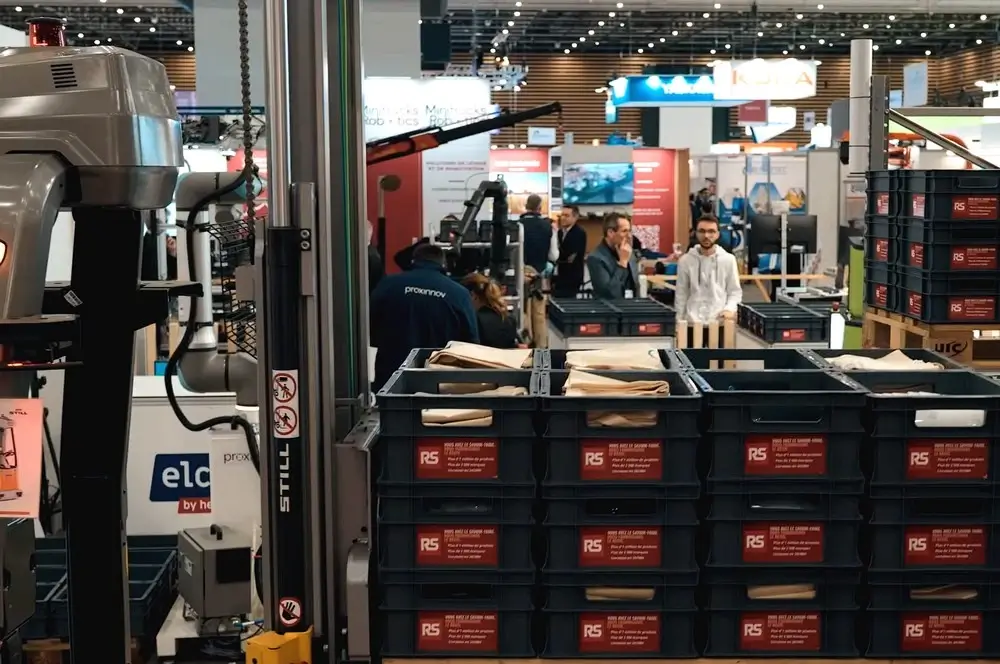
During the latest L-DIH Crossborder Tour, a visit to the "Connected Warehouse by GI" area at the Global Industrie trade fair provided a delegation of fifteen Luxembourg industrialists with more than just a technological showcase: an immersive journey into the future of warehousing.
3D and virtual reality: designing and securing the warehouse of tomorrow
What better way to plan your warehouse layout than with a 3D simulation? RealityCad enables visualisation and manipulation of 3D files in virtual and augmented reality to design future installations, considering environmental and existing constraints (walls, pillars, machine dimensions, etc.).
This solution offers a comprehensive tool for design review, prototyping, testing, simulations, and assembly assistance, allowing immersion in a future environment before ordering any components.
Laying the foundations: a floor designed for Industry 4.0
Everything begins beneath our feet. Before robots can move or sensors transmit data, the physical infrastructure must be suitable. Module Carré’s modular industrial floor coverings, installed without glue or heavy preparation, allow for rapid adaptation to changes in warehouse activity.
A discreet yet foundational solution, capable of supporting loads up to 6 tonnes, illustrating that logistics transformation starts with space design.
Safety and security: managing access
The European Machinery Regulation 2023/1230, effective from July 2023, will be mandatory from 20 January 2027. It introduces new rules for access management, machine security, and cybersecurity solutions. Pilz offers a system for managing connections to badge systems or ATM access, accompanied by risk analysis.
How can compliance with mandatory personal protective equipment be monitored in diverse working environments? The CODA Systèmes gantry, showcased at the Global Industrie trade show, provides real-time automatic detection without visual control.
Depending on initial settings, it instantly identifies which equipment is worn correctly and which is not. This tool is both protective and raises awareness about the importance of safety instructions.
Automating flows: mobile robots and assisted handling
Once the framework is established, flows come to life. Autonomous mobile robots (AMRs) animate the scene, with Meanwhile demonstrating mobile robots using natural navigation.
Trajectory calculation is conducted in real time, considering surrounding obstacles (including humans) without requiring fixed infrastructure. The robot can fetch objects on demand or follow a defined process, automatically recharging when not tasked, capable of covering 25 km daily.
VisionNav Robotics presents solutions for scenarios requiring precision (ground transport, stacking, etc.). Their autonomous trucks with 3D vision navigation operate in narrow aisles and complex environments without floor markings, enabling automated truck loading and unloading.
Agilox offers intelligent mobile equipment for automating internal pallet transport, also without floor markings.
In a complementary vein, Bosch Rexroth SAS introduces Active Shuttle, a mobile robot combined with a connected workstation. This combination exemplifies future intralogistics: an operator supported by intelligent equipment, ensuring parts arrive at the right place and time without unnecessary movements.
The operator at the centre: ergonomics and handling assistance
Automation does not mean excluding humans; it relieves them from restrictive tasks. ATIS demonstrates this with industrial manipulators designed to significantly reduce the physical effort of logistics and production operators. Lifting, depositing, and directing loads become assisted, precise actions with no health risks.
In an industry where musculoskeletal disorders lead to work stoppages, this solution addresses both human and economic challenges, allowing easy handling of heavy loads with manual guidance.
Fanuc collaborative robots, equipped with 3D vision, automate sorting parcels and envelopes on conveyor belts. They identify, grasp, and orient objects of varying shapes at a rapid pace, demonstrating the convergence of industrial robotics and applied AI.
The Hub One solution facilitates real-time inventory management, optimises order preparation paths, and reduces errors. Using simulations and digital twins, it centralises information on a single dashboard, measuring occupancy rates or indicating unmoved pallets at specific locations.
Locating parts in a bin, transmitting coordinates to a six-axis bin picking robot for collection and deposition: this is offered by the Hupico automatic parts feeding system, recalculating systematically if parts move in stock, processing each part in under two seconds.
Control, store and control in real time
Storage management is a constant challenge for logistics managers. Modula provides a vertical solution with automated warehouses using tablets.
By exploiting height rather than surface area, these systems with internal drawers supporting up to 990 kg multiply storage capacity while reducing operator movement.
Real-time control: intelligent warehouse supervision
A connected warehouse is primarily a visible warehouse. 2Gi Technologie presents its SCADA (Supervisory Control And Data Acquisition) platform for warehouse supervision, acquiring real-time data from equipment, production lines, or critical infrastructure.
Operators can monitor key variables (flow rates, temperatures, machine states, etc.) and interact with the system using natural language processed by large language models (LLMs) to manage dynamic dashboards, automatic alerts, and flow traceability.
Quality Control: Machine Vision and AI for Reliability
Ultimately, quality can no longer rely solely on human control. Aprex Solutions develops a quality control system using machine vision and AI, capable of automatically detecting product defects as small as a tenth or hundredth of a millimeter on conveyors at high speed.
L-DIH: your entry point to the connected warehouse
The connected warehouse is not a product bought off-the-shelf; it is a project built gradually according to operational constraints and priorities. Solutions presented to Luxembourg companies at the Global Industrie exhibition highlight the richness and maturity of the existing offer, enabling manufacturers of all sizes to identify their entry point into this transformation.
The shift towards a connected warehouse is not only technological but also cultural and organisational. Luxembourg Digital Innovation Hub (L-DIH) experts support Luxembourg companies at each transition stage: digital maturity diagnosis, suitable solution identification, supplier connections, and guidance towards available public aid. The question is no longer about the relevance of the connected warehouse, but where to begin.