Industrial applications of digital twins
During the L-DIH Crossborder Tour in Paris, Luxembourg companies explored the application of digital twins in industrial settings.
 Jean-Michel Gaudron
24/04/2026
A digital twin is a virtual representation of a physical process or system, updated in real time through sensors, physical models, and artificial intelligence algorithms. It replicates the behaviour of its real-world counterpart, enabling the testing of scenarios—including extreme ones—without physical or financial risks.
The four digital twin models for industry
- Operational digital twin – This is the most commonly used model. It reflects the current state of equipment or industrial processes in real time, based on sensor data streams. Mickael Desloges, Senior Advisor - Assessments & Roadmaps at Luxinnovation, explains: "Thanks to this model, downtime can be reduced, maintenance costs lowered through early anomaly detection, production stability improved, and optimisation cycles accelerated."
- Digital simulation (or predictive) twin – This model goes beyond observation, enabling the testing of scenarios before real-world interventions. It allows for parameter adjustments, performance evaluations, and the anticipation of deviations without incurring the risks or costs of physical experimentation.
- Collaborative digital twin (or system engineering) – This model supports the design of complex systems, particularly those with significant software components, such as space launchers, airliners, or automobiles. It formalises engineering knowledge, automates verification processes, and simulates system operations before deployment. Additionally, it generates embedded code directly from simulation data.
- Cloud (or distributed multi-site) digital twin – Utilising cloud technology, this model offers scalability, secure data access, and integration with existing IT and production systems. It enables remote monitoring, centralised analytics, and data-driven decision-making across multiple sites without requiring significant local infrastructure investments.
Designing a useful digital twin requires more than just data collection. Prune Gautier, LIST
In Luxembourg, the Luxembourg Institute of Science and Technology (LIST) broadens the concept of digital twins to include wider environments such as nature, buildings, and industry. This approach facilitates the modelling of systems like energy networks and complex industrial infrastructures, promoting sustainability and circularity.
Prune Gautier, researcher at LIST, highlights: "At LIST, we believe that designing a useful digital twin requires more than just data collection. It involves creating a coherent bridge between physical models, real-time measurements, and computational intelligence. Our aim is to advance the digital twin approach—from experimental data acquisition and model integration to visualisation, validation, and scenario testing—to enable both reactive and predictive decision-making."
Real-world applications of digital twins
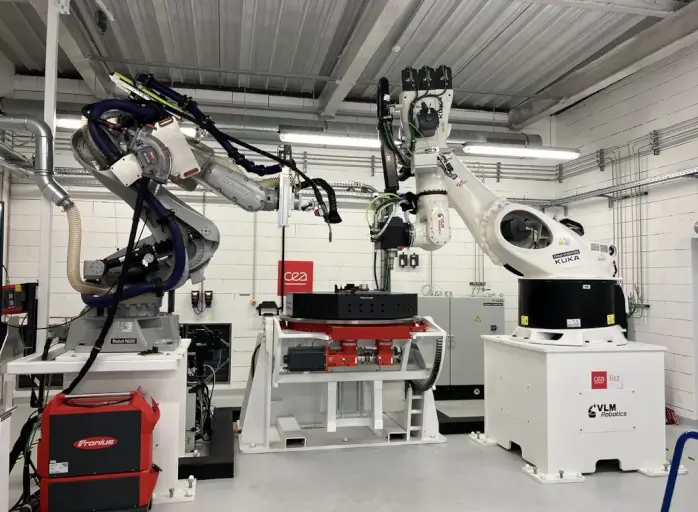
Luxembourg industrial companies participating in the L-DIH Crossborder Tour (Paris) 2026 had the opportunity to witness diverse applications of digital twins during their visit to CEA-list's PRISM innovation platform in Paris-Saclay. The platform focuses on digital technologies for industry, showcasing areas such as digital inspections, continuity in additive manufacturing, AI-driven robotic solutions, and software engineering.
CEA-list, an applied research laboratory affiliated with the French Atomic Energy and Alternative Energies Commission (CEA), employs around 1,000 people, with 15% being doctoral students. This visit was organised under AI-Matters, a European initiative aimed at accelerating the adoption of artificial intelligence in manufacturing. Through Testing and Experimentation Facilities (TEFs), PRISM serves as an open technology platform for testing, validating, and deploying innovative solutions in additive manufacturing and AI for European manufacturers.
Clarisse Poidevin, Director of Innovation and Platforms at CEA List and coordinator of the French node of TEF AI-Matters, describes: "With R2I – Interactive Intelligent Robotics, we provide an agile and scalable space to support industrial scenarios from design to deployment in factories and workspaces. By leveraging AI and interactive digital twins, we incorporate spatial and temporal dimensions, as well as human presence, into the models."
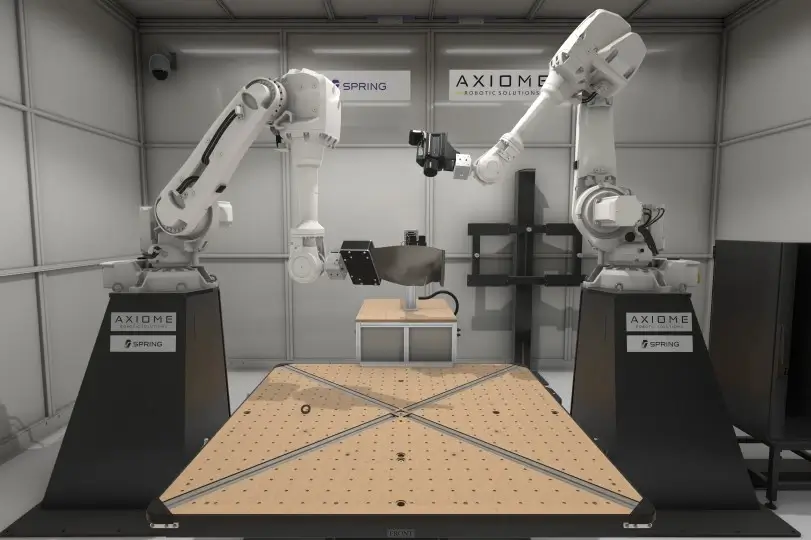
This approach facilitates the training of future operators and the planning and visualisation of robotic cells within production lines. Virtual or augmented reality enables users to preview flows, identify technological limits, and better understand machine interactions. For example, a robot demonstrated during the tour replicates the movements of human operators for industrial sanding tasks, matching their range and intensity. This technology has applications in aeronautics and automotive manufacturing, where complex geometric shapes can be handled more effectively.
Digital twins offer several advantages:
- Simplify robotic operations, including programming and trajectory visualisation.
- Train operators using mixed reality.
- Preview and adjust digital configurations in virtual reality.
- Train artificial intelligence models.
Digital twins in the Luxembourg ecosystem
The Luxembourg Digital Innovation Hub (L-DIH) provides free support to Luxembourg industrial companies in exploring and implementing digital technologies, including digital twins. The consortium comprises Luxinnovation, LIST, the Luxembourg House of Cybersecurity, and the University of Luxembourg.
To further promote understanding of digital twins, a workshop titled " will take place at LIST's premises (Maison de l'innovation in Belval) on 28 April 2026, from 09:00 to 13:00. Open to engineers, data scientists, quality specialists, and industrialists, the workshop will offer hands-on insights into the digital twin approach.
If you have an industrial project or wish to learn more about digital twins and receive tailored support—whether for diagnostics, roadmaps, or implementation—contact the L-DIH team.