Additive manufacturing: design freedom
New geometries, lighter parts, tailor-made production: additive manufacturing is reshaping industry and the possibilities are (almost) endless.
 Jean-Michel Gaudron
22/06/2026
Whether we talk about additive manufacturing or 3D printing, the concept is the same: it refers to a set of processes that build a part layer by layer by adding material, rather than by removing it as in traditional machining. This approach is profoundly transforming industrial production patterns.
The foundations of this technology date back to the early 1980s with the work of Dr Hideo Kodama in Japan, who laid the groundwork for layer-by-layer manufacturing, followed by the invention of stereolithography (SLA) by the American Chuck Hull, the first technology capable of transforming digital files into solid objects using a UV-sensitive resin.
The concrete benefits of 3D printing for industry
With technological progress, many achievements have followed one another:
- the first metal components made directly from digital files, without moulds (1994 in Germany)
- the first artificial kidney (2002 in the United States)
- the first functional aircraft (2011 in England)
- the first habitable 3D-printed house (2018 in France)
- …
For industry, the benefits of this now widely accessible technology are tangible. Additive manufacturing paves the way for new geometries, lighter materials and structures and more advanced functionalisation. "Additive manufacturing makes it possible to produce optimised parts on demand, while limiting development time and supply chain issues," says Maxime Delmée, founder and CEO of AM4AM (Advanced Materials for Additive Manufacturing), a company specialising in the development of cutting-edge metal powders for additive manufacturing.
Among metal technologies, the Wire Arc Additive Manufacturing (WAAM) process is the benchmark for a large number of use cases involving large parts. It uses a plasma in the form of an electric arc to melt a metal wire and deposit the metallic material. This is the process on which Prisma, the collaborative and multi-process platform of the French Alternative Energies and Atomic Energy Commission (CEA)'s Technological Research Directorate, is based and which the delegation of Luxembourg industrialists visited during the DIH Crossborder Tour at the end of April 2026.
Prisma: additive manufacturing (AM) platform by energy deposition of the CEA's Directorate for Technological Research (DRT)
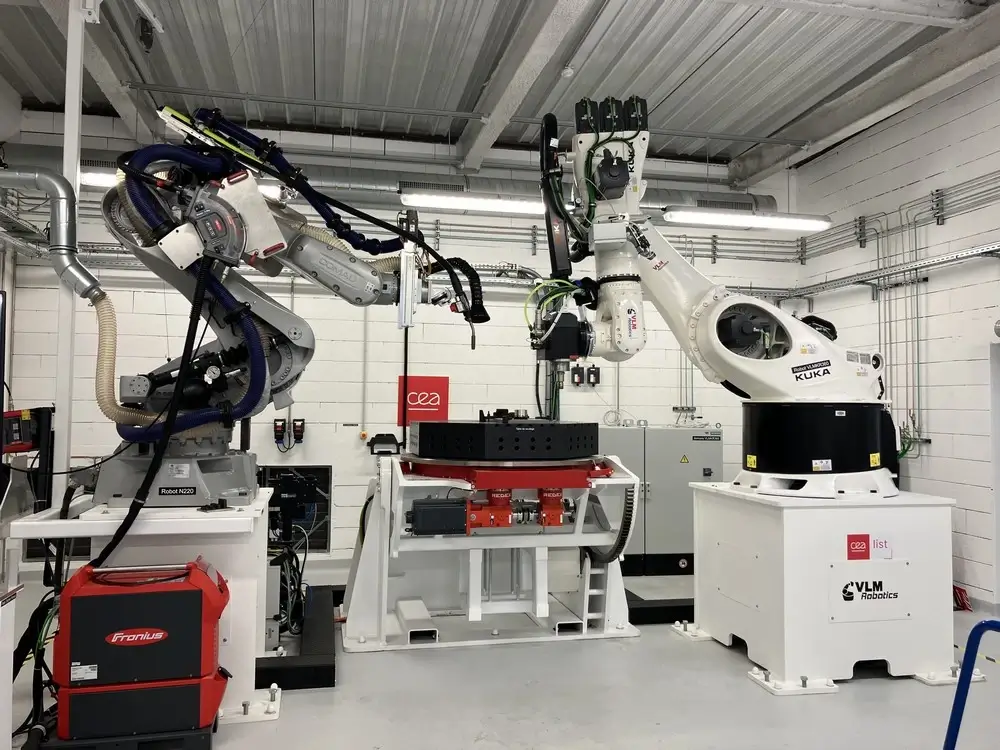
Launched in 2024, Prisma is a metal additive manufacturing platform using energy deposition, positioned at the crossroads of industrial needs and technological developments. It is part of a fleet of around ten CEA platforms dedicated to additive manufacturing processes and materials.
Its uniqueness lies in its end-to-end digital chain, including the platform's digital twin. Prisma combines two robots: the first uses the arc-wire process (WAAM) to manufacture large metal parts, the second manufactures and finishes parts or embeds sensors for process monitoring or quality control.
"Metal parts made using AM can range from dental crowns to boat propeller blades, mould inserts or armoured vehicle components," explains Dr Anaïs Baumard, Operational Manager of the CEA's Prisma AM platform. "As for examples of applications obtained with the WAAM process, we can mention Airbus, which has applied reinforcements to titanium parts, and Ariane Group, which is considering manufacturing spindle nozzle reinforcements with this process.
Additive manufacturing allows the creation of unique parts, which may also have benefited from topological optimisation, that is a calculation method that makes it possible to predict the shape that the part would have had in nature according to the constraints to which it is subjected. "It also reduces material losses and lightens the final parts."
Real-time quality control
In addition to "à la carte" production offering multiple options (manufacturing, machining, monitoring and/or control), supported by a facility with sixteen degrees of freedom, the platform develops another major asset: real-time quality control of parts. "By combining digital simulation and online instrumentation, the platform aims to detect defects as soon as they appear. The idea is to support decision-making during manufacturing when a defect is detected: to continue manufacturing, to interrupt it or to continue it having identified the defect (position, nature, size) for deferred processing."
Multiple data are constantly generated on the platform (experimental and digital), most of which are retrieved in real time. Depending on the manufacturing requirement, different sensors can be used. The composition of the alloy used for additive manufacturing can be measured, for example, using X-ray fluorescence, which makes it possible to evaluate the evaporation of certain components during manufacturing.
The CEA is designing Prisma as a collaborative workspace open to interested industrial partners such as those in land transport, aeronautics, energy and the naval and defence sectors. The teams offer support for the deployment of the process in their production line as well as part reloading tests, that is the addition of material to repair existing components.
"This visit reinforced my view that the evolution of industry will involve digital tools such as digital twins in order to limit empirical development phases and accelerate the implementation of new solutions," notes Maxime Delmée.
Support from the Luxembourg Digital Innovation Hub
At the initiative of the Luxembourg Digital Innovation Hub (L-DIH), a delegation of around fifteen Luxembourg industrialists took part in the 2026 edition of the L-DIH Crossborder Tour, a structured immersion in the heart of European innovation. From CEA-List in Saclay to the Global Industrie international trade show, the largest industry event in France, participants were able to see European best practices first-hand and gain the keys to refining their digital strategy.
They were able to develop a better understanding of European innovation support schemes and discover how to test, evaluate and integrate technological solutions adapted to their needs. "Following this visit, we reflected on the possibility of converting our powder materials into wire for the WAAM-type printers used by the CEA. There is no concrete action on this issue yet, but if we decide to go for it, we will know directly who to contact," says Mr Delmée.
This testimony illustrates in a concrete way the relevance of L-DIH's mission for companies. "Aware that SMEs are very busy and lack time, L-DIH takes advantage of events such as this Crossborder Tour to raise awareness of innovations that are relevant to them," explains Mickael Desloges, Senior Advisor – Assessments & Roadmaps at Luxinnovation.
It is then possible, in a next step, to guide companies towards the appropriate national and European aid mechanisms.
Take action with L-DIH
The Luxembourg Digital Innovation Hub (L-DIH) supports industrial companies in their digital transformation:
- assessment of your digital maturity
- identification of national and European aid
- connection with technology experts and platforms
Contact L-DIH to discuss your digital roadmap via the contact form.